Introduction
Sometimes that’s the first clue.
A parent notices that getting ready for school takes forever. A shirt button becomes a battle. Holding a pencil looks uncomfortable. Cutting paper for a school project ends in frustration.
None of these things seem huge on their own.
That’s why many families don’t think much of it in the beginning.
Children develop differently, after all.
But when the same struggles keep appearing in different situations, it becomes harder to ignore.
It Usually Shows Up in Everyday Life
Most children won’t tell you they have difficulty with fine motor skills.
What they might say is:
“I don’t want to draw.”
Or,
“Can you do it for me?”
Sometimes they simply avoid the activity altogether.
Parents often think the child is uninterested. In reality, the task may feel harder than it looks.
Something as ordinary as opening a lunch box, using a spoon neatly, or fastening a zipper requires a surprising amount of control from the hands and fingers.
When that control is still developing, everyday routines can become tiring.
Occupational Therapy Doesn’t Start Where Most People Expect
A lot of parents arrive expecting handwriting practice.
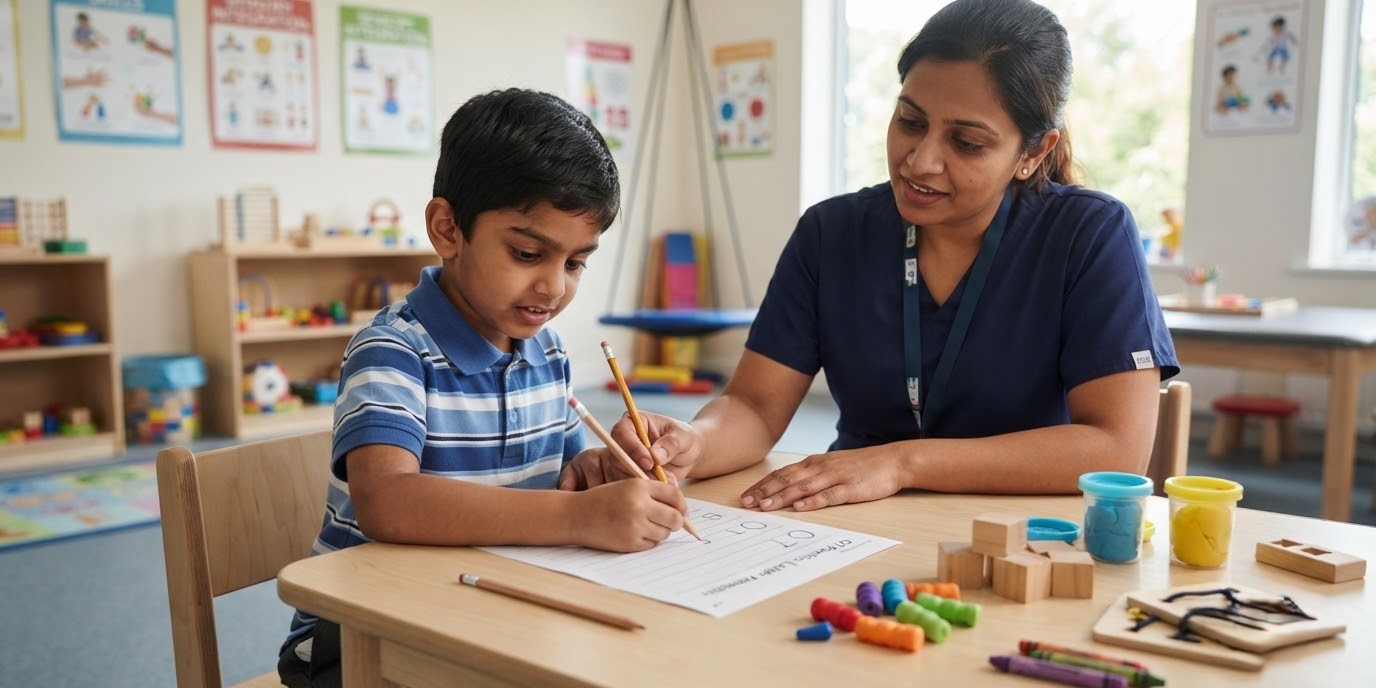
Then they walk into a session and see their child building with blocks or playing with putty.
It can be confusing at first.
“How is this helping with writing?”
The connection becomes clearer once you understand what the therapist is looking for.
Before a child can write comfortably, they need hand strength, finger control, coordination & They need to be able to plan and organise movements.
Those skills don’t always develop automatically.
That’s why therapy often focuses on the building blocks first.
Progress Is Usually Quiet
One interesting thing about occupational therapy is that improvement rarely arrives in one dramatic moment.
Parents don’t usually wake up one morning and say, “Everything is fixed.”
Instead, they notice little things.
A child who always asked for help with buttons suddenly manages them alone.
Handwriting that used to be rushed becomes easier to read.
Coloring stays inside the lines a little more often.
The changes are small.
Then one day you realise those small changes have added up.
Confidence Changes Too
This part often gets overlooked.
Children notice when something feels difficult.
They notice when classmates finish first.
They notice when adults step in to help every time.
Over time, that can affect confidence.
As skills improve, something else tends to improve alongside them.
Children become more willing to try.
They volunteer for activities they once avoided.
They stop assuming they will struggle.
For many families, that’s one of the most rewarding parts of the process.
What Happens Outside the Therapy Room Matters
The clinic is only a small part of a child’s week.
Most learning happens during ordinary moments.
Playing with building toys. Helping in the kitchen. Drawing pictures. Folding clothes. Making simple crafts.
None of these activities feel like therapy.
Yet they give children opportunities to practice the same skills in a natural way.
That’s often why therapists spend so much time talking with parents.
The goal isn’t to create extra work at home. The goal is to make everyday life part of the learning process.
Knowing When to Ask for Help
There isn’t a perfect checklist.
Some children struggle with writing. Others have difficulty with dressing or self-care tasks. Sometimes a teacher notices a pattern before anyone else does.
And sometimes parents simply have a feeling that things seem harder than they should.
That feeling is worth paying attention to.
An assessment doesn’t automatically mean therapy is needed. Sometimes it simply provides reassurance.
Either way, having answers is usually better than wondering.
Final Thoughts
Occupational therapy is not really about pencils, buttons, or scissors.
Those are just the things people notice first.
What therapists are often working on is something deeper — helping children feel more capable in their everyday lives.
And when everyday tasks stop feeling like obstacles, children usually gain something far more valuable than a new skill.
They gain confidence in themselves.