Introduction
“Why isn’t my child talking like other children?”
It is a question many parents quietly worry about. Maybe your child understands what you say but uses only a few words. Maybe they talk, but most people outside the family struggle to understand them. Or perhaps you keep hearing, “Don’t worry, they’ll start talking when they’re ready.”
Children do develop at different speeds, so a small difference does not always mean there is a problem. But Speech Delay in Children can happen for several reasons, and knowing when to look for help can make things much easier for both parents and children.
Every Child Learns to Talk at Their Own Pace
There is no single day when every child suddenly starts speaking.
Some children are early talkers. Others take more time. You may even see two children of exactly the same age developing communication skills very differently.
For parents, comparison can make things confusing. Your friend’s child may already be speaking in short sentences while your child is still using single words. That doesn’t automatically mean your child has a serious developmental problem.
What matters is the overall pattern.
Is your child learning new words? Are they trying to communicate? Do they understand what you say? Are their communication skills gradually improving?
These things can tell you much more than simply counting the number of words your child knows.
What Can Speech Delay Look Like?
Speech delay isn’t always easy to spot.
Some children may use very few words for their age. Others may understand plenty but struggle to express themselves. A child might point, pull your hand, or make sounds instead of using words to ask for something.
You may notice that your child:
- Uses fewer words than expected for their age
- Isn’t adding new words over time
- Has difficulty putting words together
- Is difficult for people outside the family to understand
- Becomes frustrated when others don’t understand them
- Rarely tries to communicate their needs
- Doesn’t seem to understand simple everyday instructions
- Has stopped using words or communication skills they previously had
One sign alone doesn’t provide a diagnosis. But if several of these things are happening, it is reasonable to discuss them with a professional.
What If Your Child Understands Everything?
This is a common situation.
A child may understand simple instructions, know familiar objects and people, and follow conversations surprisingly well. Yet when they want something, they may point instead of saying what they want.
This happens because understanding language and expressing language are different skills.
During an evaluation, a speech-language professional will usually look at both sides. They may observe how the child understands questions, follows instructions, uses gestures, plays, interacts with others, and tries to communicate.
So don’t focus only on how much your child talks.
Could Hearing Be Affecting Speech?
It can.
Children learn speech sounds by listening to the people around them. If a child cannot consistently hear those sounds clearly, learning and using speech can become more difficult.
This doesn’t always mean severe hearing loss. Even temporary hearing difficulties, such as those associated with recurring ear problems, may affect how clearly a child hears speech.
For this reason, a hearing evaluation may sometimes be recommended when a child has delayed speech.
Checking hearing doesn’t mean that professionals have already decided there is a problem. It simply helps rule out one possible reason and gives a clearer picture of the child’s communication development.
When Should Parents Ask for Help?
You don’t have to wait until your child is much older.
If you have been concerned about your child’s communication for some time, talking to your pediatrician or a speech-language professional can be a useful first step.
You may find that your child’s development is within a normal range and that simply monitoring their progress is enough.
Or, the assessment may show that your child could benefit from some extra support.
Either way, getting information is better than spending months wondering whether you should have done something sooner.
What Happens During a Speech Evaluation?
Many parents imagine a formal test where their child has to sit quietly and answer questions.
With young children, it often looks quite different.
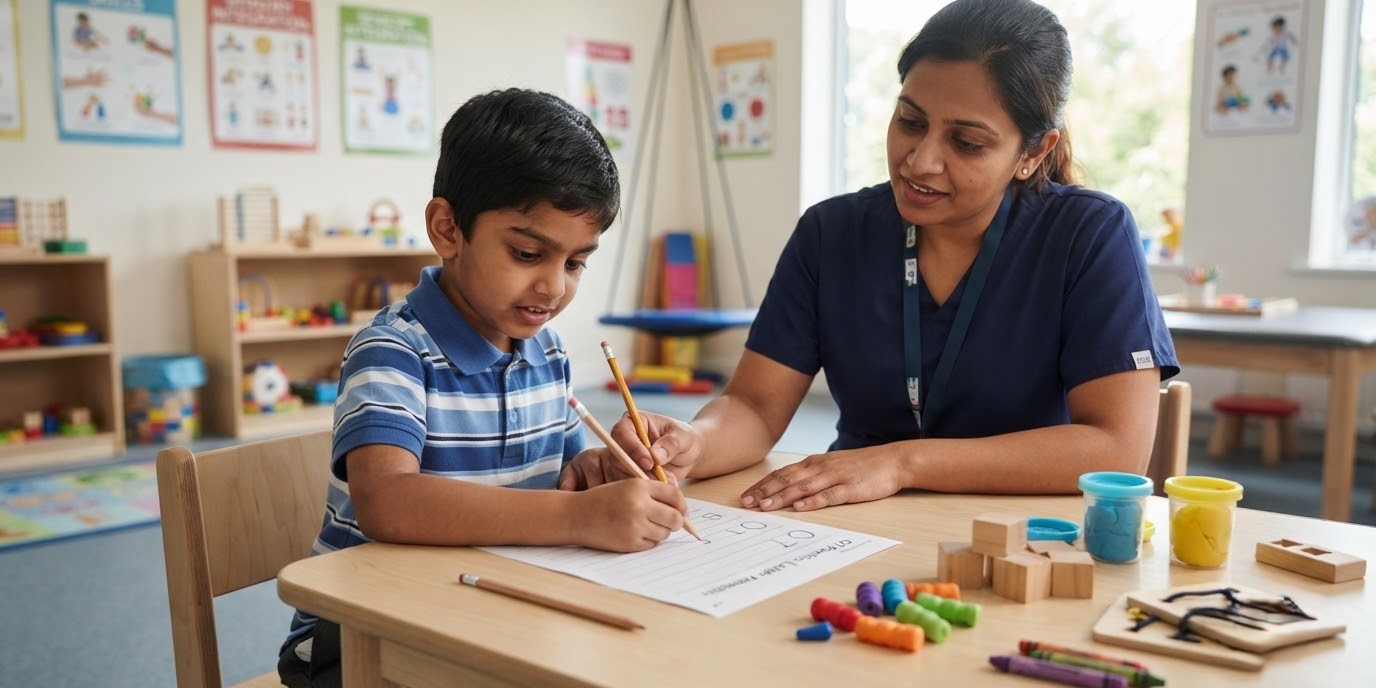
A speech therapist may watch the child play with toys, look at picture books, interact with their parent, or try different activities. They may observe how the child asks for things, responds to their name, copies sounds, follows instructions, or gets someone’s attention.
The parent also plays an important role.
You may be asked when your child’s first words appeared, what words they use now, how they communicate at home, and whether you have noticed any changes.
These everyday details can help the professional understand the child’s communication more clearly.
Can Speech Therapy Help?
Speech therapy is not simply about making a child say more words.
Depending on the child’s needs, therapy may work on vocabulary, sentence building, understanding language, speech sounds, communication skills, or social interaction.
For young children, sessions are often based around play.
A therapist might use toy animals, blocks, bubbles, picture books or pretend play. To a parent, it may look like the child is simply playing. But these activities can create opportunities to practise requesting, naming, copying, taking turns and communicating.
The approach also depends on the child. There isn’t one activity that works equally well for every child.
What Can Parents Do at Home?
You don’t need to turn your home into a therapy centre.
Everyday life already gives you plenty of opportunities to encourage communication.
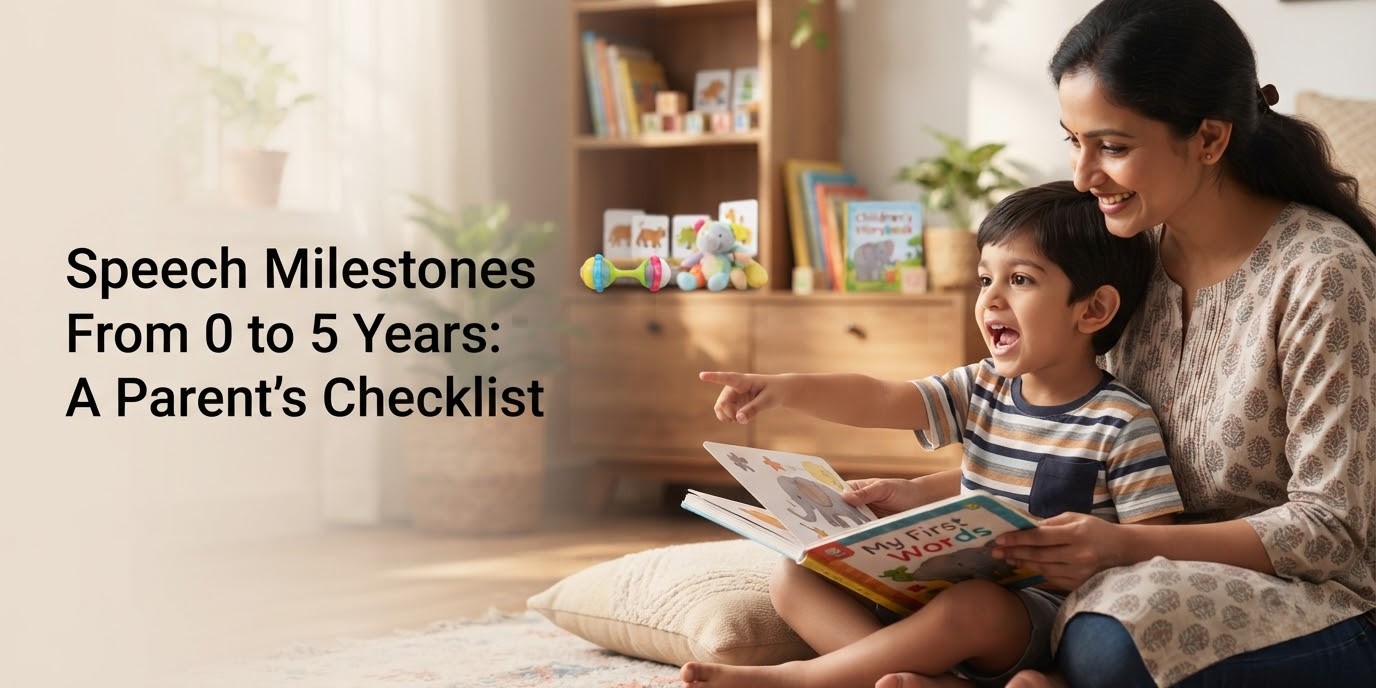
Talk about what you’re doing while cooking or getting dressed. Name things you see during a walk. Look at picture books together. Sing songs your child enjoys. If your child points toward a toy, put the word to it: “Car? You want the car?”
And give them a moment to respond.
Parents sometimes speak very quickly because they want to help. But a short pause can give a child the opportunity to make a sound, use a gesture, or attempt a word.
Most importantly, keep communication enjoyable. Children are more likely to engage when they don’t feel like they’re constantly being tested.
Don’t Compare Your Child With Every Other Child
It’s very easy to fall into this habit.
You see another child of the same age talking more and immediately start wondering whether your child is falling behind.
Try to look at your child’s own progress instead.
Has your child learned something new in the last few weeks? Are they communicating more than before? Are they showing interest in people and their surroundings?
These changes matter.
At the same time, if progress seems to have stopped or your concerns are increasing, don’t ignore that feeling simply because someone tells you to “wait.”
What If Your Child Loses Words They Already Had?
This deserves particular attention.
If a child stops using words or communication skills they had previously developed, speak with a pediatrician or qualified professional.
It may be necessary to look at hearing, speech and language development, or other areas of development to understand what has changed.
The goal isn’t to panic or assume the worst. It is simply to understand why the change happened and whether support is needed.
Final Thoughts
Speech Delay in Children can look different from one child to another. Some children simply need more time, while others may benefit from speech therapy, hearing support, or a broader developmental evaluation.
Parents don’t need to diagnose the problem themselves.
If your child isn’t gaining new communication skills, is difficult to understand, struggles to express basic needs, or has lost skills they previously had, talk to a pediatrician or speech-language professional.
And remember, asking for help doesn’t mean something is wrong with your child. Sometimes it simply means you’re giving them another opportunity to learn, communicate and grow with the right support.